
Let me begin with a fact that may or may not be an argument: there are no wild alpacas.
Search the Andean altiplano as long as you like; you will find vicuñas, their graceful undomesticated ancestors, but never an alpaca that owes nothing to us. The alpaca is the product of some six thousand years of human selection: for fleece, for temperament, for the ability to live alongside people. Some philosophers who call themselves artefactualists would say that this makes the alpaca an artifact: an object that exists because someone intended something. A living, humming, occasionally spitting artifact.
I don't know if they're right. This blog is not here to settle that. But I keep turning the idea over, because if it's true, even partly true, a surprising number of things follow. This first post is an inventory of those "ifs."
If artifacts are real...
Artefactualists claim that artifacts are not second-class objects. A long philosophical tradition treats only "natural kinds" like electrons, tigers, and water as metaphysically respectable, and regards tables, screwdrivers, and spreadsheets as mere arrangements of respectable stuff: projections of our practical interests onto an indifferent world. The artefactualist refuses the demotion. A screwdriver, they say, is not less real than quartz, only differently real, because its existence depends on human intentions.
Suppose they're right. Then what do we say about the fact that almost everything around us, right now, is an artifact? If the made world is as real as the found world, does that mean we live inside other people's minds, solidified, shipped, and sold? Is a city a landscape or a text? And if money, laws, and corporations are artifacts too, was there ever a moment when we stepped out of nature and into... what, exactly?
Or is all of this just a category confusion, a way of taking our own conveniences too seriously?
If a tool is congealed intention...
Some artefactualists describe an artifact as an intention embedded in durable form. When a maker produces a tool, she doesn't merely rearrange matter; she freezes a proposal: this is how nails should meet wood, so that it outlives the moment of its proposing. The philosopher Risto Hilpinen put it roughly this way: an artifact is an object intentionally made under some description.
If that's true, then every tool on your desk is a message from a stranger. Whose intentions are you holding when you hold your phone? When you open a piece of software that helps you write but also harvests your attention, how many intentions are congealed in it, and how many of them are yours? The old hammer never phoned home to the blacksmith. Should we care that the new ones do? Or is that just nostalgia dressed as metaphysics?
And what about misuse? If the intention travels with the object only as an invitation, never a command, then is a paperweight made from a hammer still a hammer? Who decides: the maker, the user, the object itself?
If domestication runs both ways...
Here is the question that unsettles me most. If the artefactualists are right that we make our tools, must we also accept the converse: that our tools make us? The hand that has held hammers for a million years: is it a hand shaped by hammers? The mind that thinks in spreadsheets: does it come to see the world as rows and columns awaiting values?
Consider the alpaca again. Humans bred it, but Andean societies were equally organized around it: its shearing seasons, its herding needs, its wool economy. So who domesticated whom? And if the answer is "yes," then what should we say about ourselves and our software? Are we the shepherds of our tools, or the flock?
If durability matters...
The chipped stone axes of the Paleolithic still work. Much of what we build today exists only as long as a server does. If an artifact is an intention that has learned to wait, how long should it be able to wait? Is there a metaphysics of durability hiding inside every terms-of-service agreement? Does a tool that can be remotely disabled still belong to you in the way a hammer does, or is ownership itself changing shape under our hands?
I don't know. That's not false modesty; I genuinely don't.
The program
What might alpaca.tools become, then? Perhaps we should strive to be concious about the artifacts we make, how we make them and why we make them, and hold them up to the same conditional light. If the artefactualists are right, what is this thing? What does it intend? What does it assume about its user? What world does it quietly propose? And what might it be doing to the hand and mind that adopt it?
Maybe the artefactualists are wrong, and a tool is just a tool, and all these questions dissolve into common sense. That would be an interesting result too. But if they're right, even a little, then in a world made almost entirely of artifacts, the person who cannot read artifacts is functionally illiterate in their own environment. Wouldn't that be worth finding out?
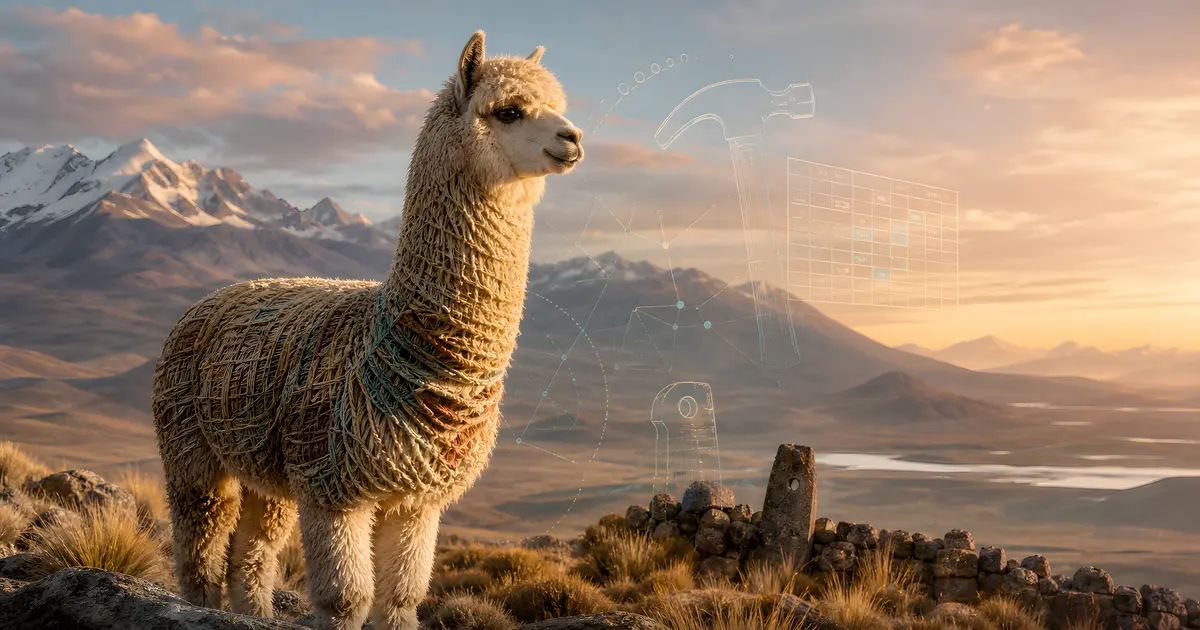
The alpaca, for its part, takes no position. It stands on the cold plateau, wearing six thousand years of human intention as a coat, if that's what a coat is, entirely unbothered.
Welcome to alpaca.tools. Mind the spitting.